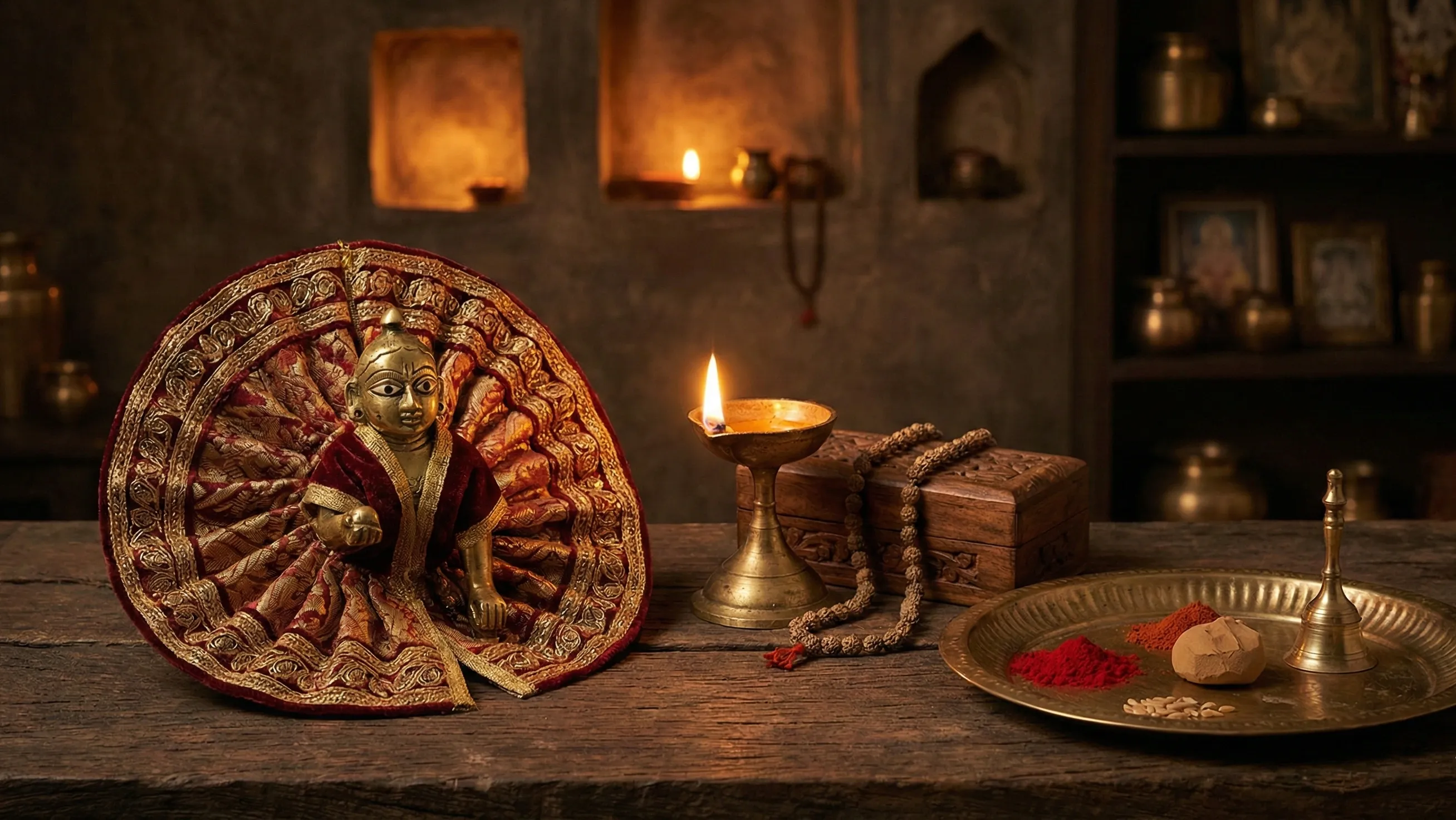
Every morning, in millions of homes across India, a devotee opens a small wooden mandir, unfolds a carefully kept poshak, and begins to dress their Laddu Gopal with quiet, unhurried love. The ritual feels intimate — a private exchange between one devotee and the small, beautiful form of Lord Krishna they have welcomed into their household. What most of us do not pause to consider, caught up as we are in the peace of that morning, is just how ancient this act truly is. The tradition of adorning a deity — clothing them, decorating them, presenting them with the very best the household can offer — is one of the oldest continuous spiritual practices in the world. It predates most religious texts that we read today. And far from being a folk custom that simply grew up around temple worship, it is a practice rooted in scripture, shaped by centuries of theological thought, and carried forward by generations of devotees who understood that how we dress our Thakurji is itself a form of prayer.
What the Scriptures Say: Vastram as Sacred Offering
The Sanskrit word for this practice is vibhushana seva — the service of adorning and beautifying the divine. Its scriptural foundations appear in the ancient texts that describe the proper forms of deity worship. The panchopachara seva (five-element worship) and the more elaborate shodashopachara seva (sixteen-element worship) both place vastram — the offering of cloth and clothing — at the centre of formal puja. In the shodashopachara system, vastram is listed alongside flowers, incense, light and food as one of the fundamental elements through which a devotee makes contact with the divine. This is not incidental. The logic behind vastram as a sacred offering runs deep: to clothe someone with care and beautiful fabric is to declare that you see them as worthy of honour, as a being of dignity and presence. When a devotee offers a fine poshak to Laddu Gopal, they are performing, in the most direct physical way possible, that ancient declaration — that Thakurji is not a stone figure or a decorative object, but a living presence deserving of the very best.
The Pushti Marg Tradition: Poshak as a Complete Theology
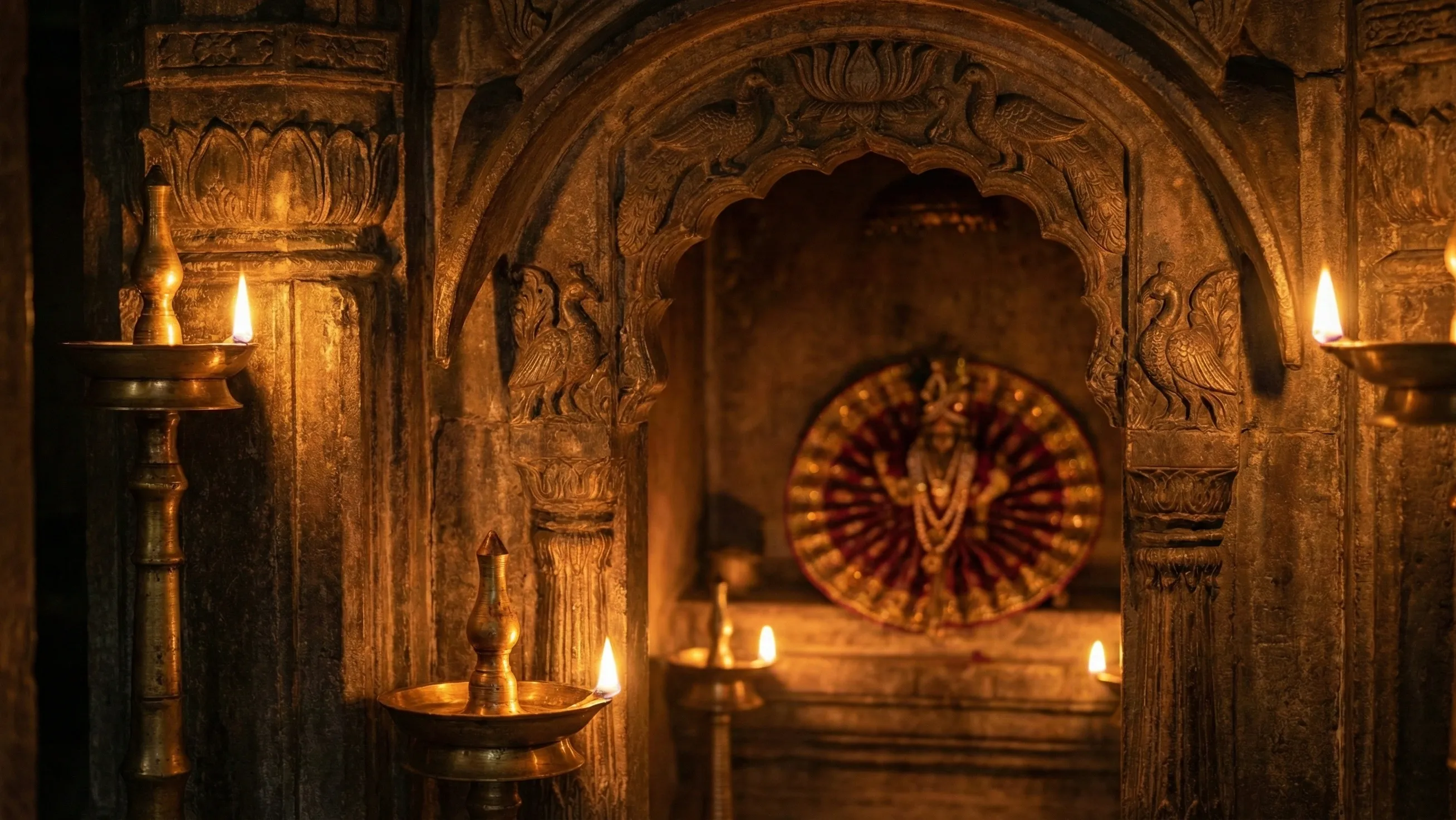
No tradition has thought more deeply about the dressing of Laddu Gopal than Pushti Marg (the Path of Grace), founded by the philosopher-saint Vallabhacharya in the fifteenth century. His vision of devotional life placed seva — the daily service of the deity — at its absolute centre, and within seva, shringar (the act of adorning and decorating) was given its fullest theological development. The most visible expression of this tradition lives in Nathdwara, Rajasthan, where the sacred Shrinathji form of Lord Krishna receives eight distinct darshanam (divine viewings) each day: Mangala, Shringar, Gwal, Rajbhog, Utthapan, Bhog, Sandhya Aarti and Shayan. Each of these darshanam comes with its own distinct poshak — a specific colour, fabric, embellishment and design appropriate to that moment of the day and that season of the year. This means that the Nathdwara tradition maintains an extraordinarily elaborate wardrobe for Shrinathji, assembled over centuries by devotees, rulers and craftspeople working together. The principle it demonstrates is profound: the deity does not simply receive one poshak — the deity is dressed according to time, mood, season and occasion, because the divine is alive and responsive, not static.
- Mangala darshan (dawn): simple, unembellished morning attire — the deity waking as any beloved member of the household would
- Shringar darshan (mid-morning): the most elaborate dressing of the day — rich fabric, full jewellery, a complete mukut
- Rajbhog darshan (midday): festival-weight poshak marking the most auspicious moment of the day
- Sandhya Aarti darshan (evening): warm, lamplit tones — fabrics that glow in firelight
- Shayan darshan (night): the shayan poshak (sleeping attire), simpler and softer, marking the close of the day's seva
A History Written in Fabric: From Cotton to Zari
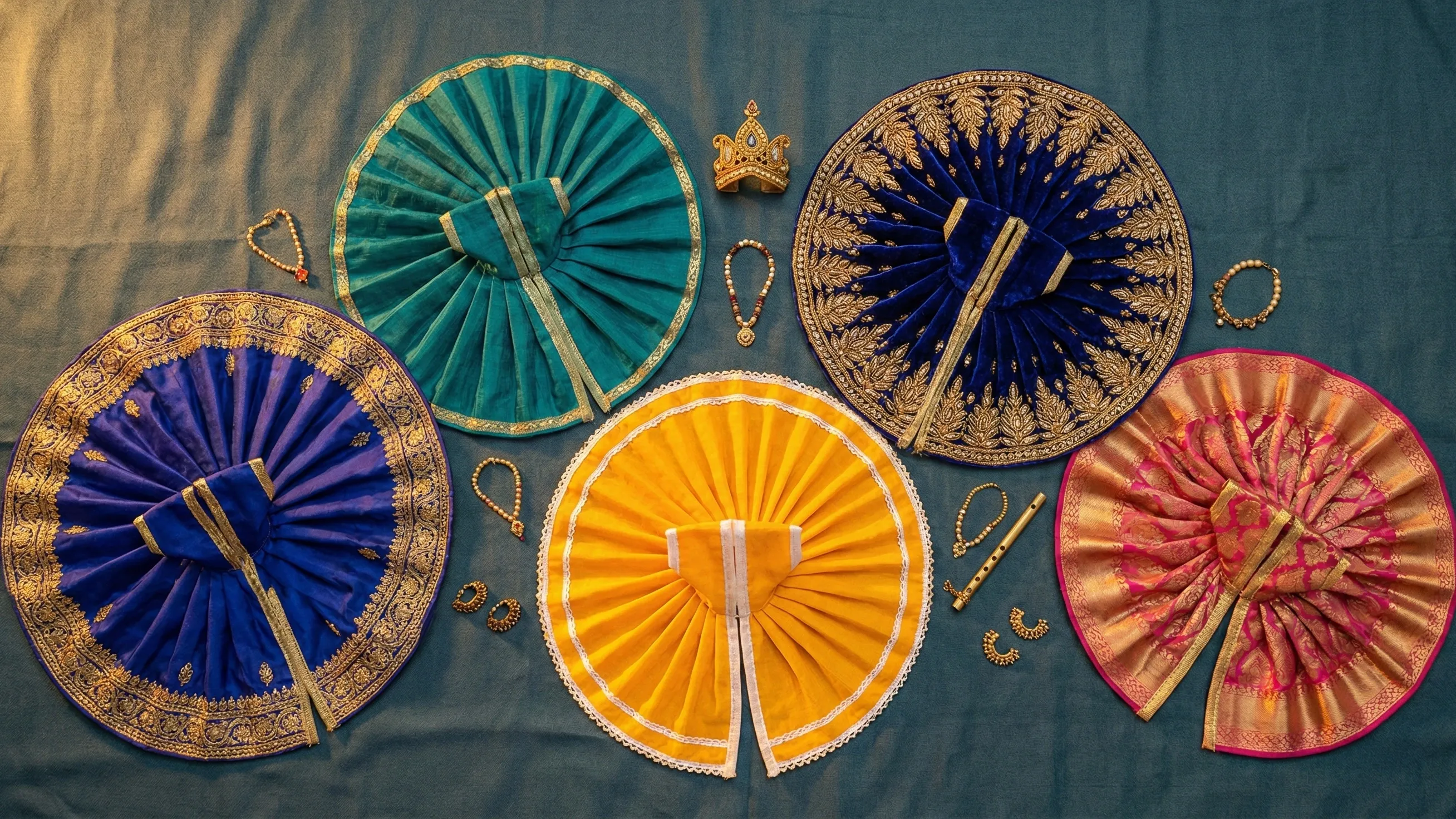
The fabrics used in poshak-making today carry centuries of trade, craft evolution and cultural exchange within them. The earliest Vaishnava traditions used simple cotton and silk dyed with plant-based pigments — indigo from the indigofera plant, turmeric yellow, pomegranate-rind red and lac-derived pink. These colours were sattvic (pure and spiritually clear) by nature, and their organic softness suited the handwoven fabrics of the time. The story changes dramatically from the medieval period onward. Zari (metallic thread weaving) from the looms of Varanasi and Surat began transforming poshak into works of genuine artisanal complexity. Gold and silver wire drawn fine enough to be woven like thread brought a new visual language to deity dressing — one of radiance, of celestial wealth, of divine kingship made visible in fabric. Then came the Mughal period, which introduced velvet to the Indian craft tradition through Persian and Central Asian trade routes. Velvet's deep pile, its ability to hold rich jewel-toned colour and its extraordinary surface for embroidery made it immediately beloved for temple and shrine use. By the seventeenth and eighteenth centuries, the combination of Varanasi zari work, Mughal-influenced velvet and the ancient tradition of plant-dyed cotton had produced the layered, sophisticated craft vocabulary that Laddu Gopal poshak-making still draws from today.
Tip: When you look at a zari border on a poshak, you are seeing a craft lineage that connects Varanasi weavers working today to the same workshops that supplied royal temples several centuries ago. The technique of drawing metal wire fine enough for weaving has changed very little in four hundred years.
The Meaning in Colour: A Theology of the Palette
Colour in the Vaishnava devotional tradition is never merely aesthetic — it is theological. The colours chosen for Laddu Gopal's poshak carry meanings that devotees across centuries have understood intuitively, even when they could not have articulated the scriptural logic behind them. Celestial blue — the colour most deeply identified with Lord Krishna himself — represents the infinite expanse of space, the vast sky that has no boundary. Krishna's complexion is described in texts as megha-shyam, the luminous blue-black of a monsoon cloud — a colour that suggests infinite depth rather than surface brilliance. Saffron, the colour of fire and of the sun, represents divine radiance: the consuming, purifying energy of the sacred flame. It is the colour of renunciation and of spiritual power in the same breath, which is why it appears so often at Janmashtami and other high-energy celebrations. Purple and deep violet, which entered the poshak palette through Mughal-era influence, have come to represent spiritual interiority — the meditative, inward-facing qualities of bhakti (devotion). Green, across multiple traditions, speaks of life, abundance and the earth. And gold — woven as zari, painted as embroidery, worked as sequin — is the colour of divine grace itself, the radiance that emanates from the sacred and marks it as set apart from the ordinary world.
A Living Lineage, Not a Museum Piece
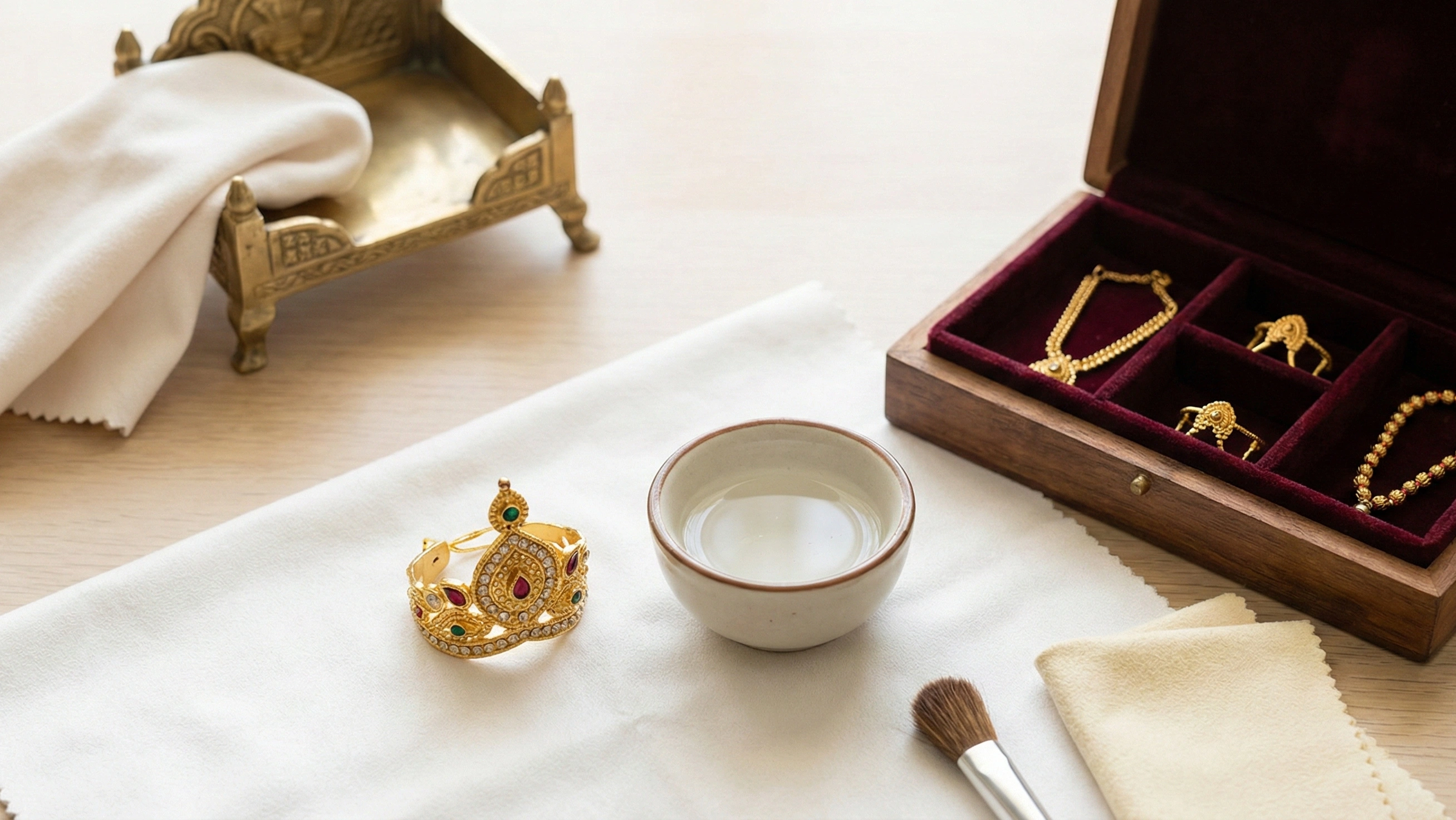
What is most remarkable about the tradition of dressing Laddu Gopal is that it has never stopped. It did not freeze at any particular historical moment and become a museum practice studied from a distance. Every morning, across India and in the homes of Indian devotees living in every part of the world, the tradition continues in exactly the form it always has — in the careful folding of a poshak the night before, in the clean hands lifted to place a mukut (crown) on Kanha Ji's head, in the choice of a specific colour for a specific festival. The mukta (pearl) and other gems set into sacred jewellery carry meanings that go back to ancient times — mukta itself shares a root with mukti, liberation, and a pearl crown (mukut) on Thakurji declares him as the Maharaja of the three worlds, the one who grants liberation to those who love him. When we at Gopalji Fashion make a poshak in our workshop in Gurgaon, we are aware that every stitch we place connects the person who will receive it to this long, unbroken lineage. The devotee who dresses their Thakurji this morning is doing exactly what a devotee in Nathdwara did four centuries ago, what a devotee in Mathura did before that, and what the earliest practitioners of vibhushana seva did long before any of the historical record we can trace today. That continuity is not a small thing. It is, in its way, a miracle.
Tags