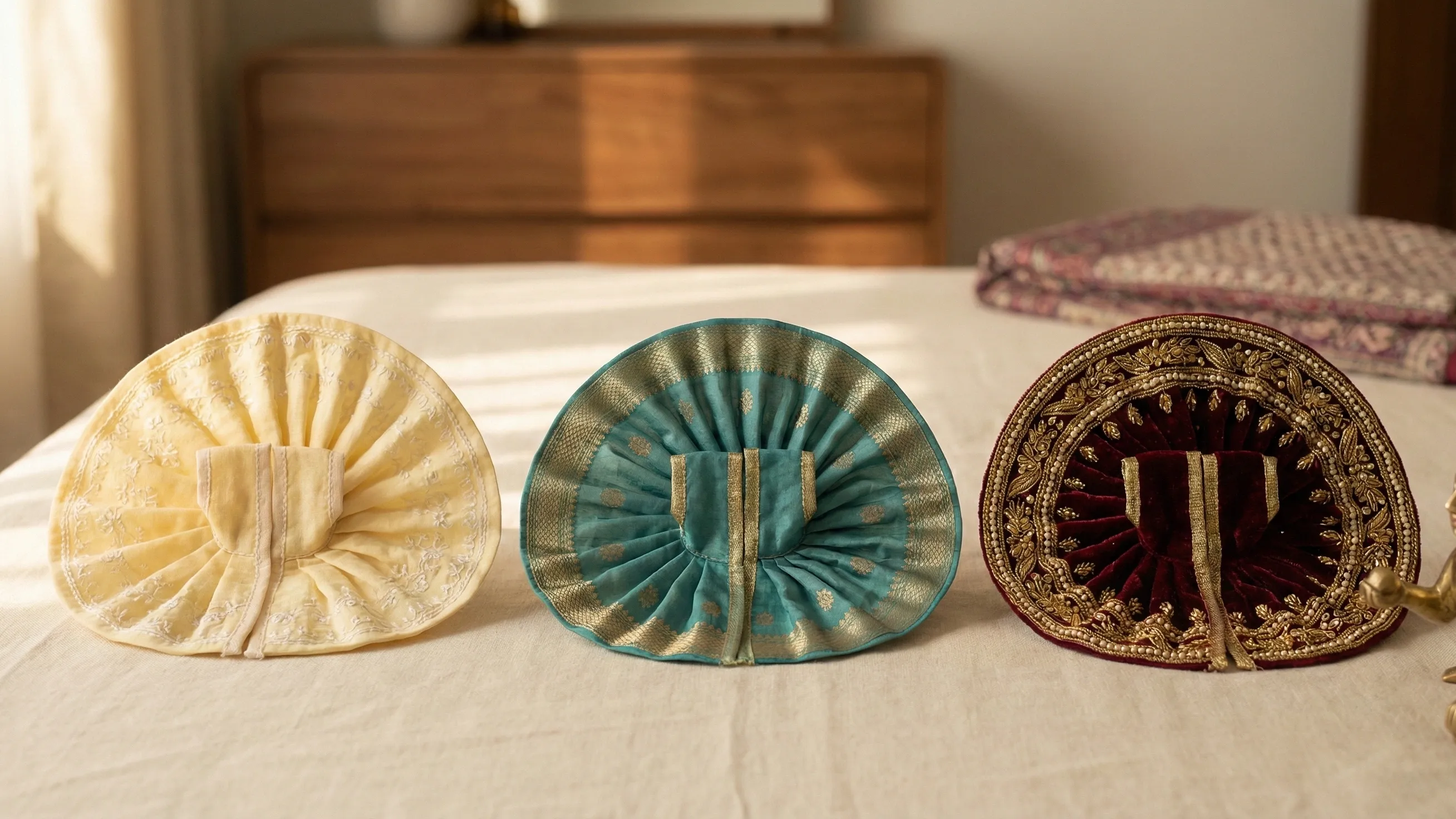
One of the quiet surprises waiting for every devotee who has dressed more than one Laddu Gopal idol is this: the same numbered size does not look the same on every murti. A Size 4 poshak that drapes beautifully on one Kanha Ji may pull awkwardly across the belly of another or hang loose at the shoulders of a third. This is not a flaw in the poshak, and it is not a mistake in the sizing chart. It is simply the reality of handcrafted devotional idols, which are made by artisans across Mathura, Vrindavan, Jaipur and other craft centres, each working within their own tradition and proportion conventions. Two murtis bearing the same size label can differ meaningfully in torso width, shoulder breadth, the curve of the stomach, and even the angle at which the arms are set. Once you understand this, you stop chasing a perfect standard size and start looking for something more useful: a poshak designed to adjust.
How Adjustable Poshak Features Work
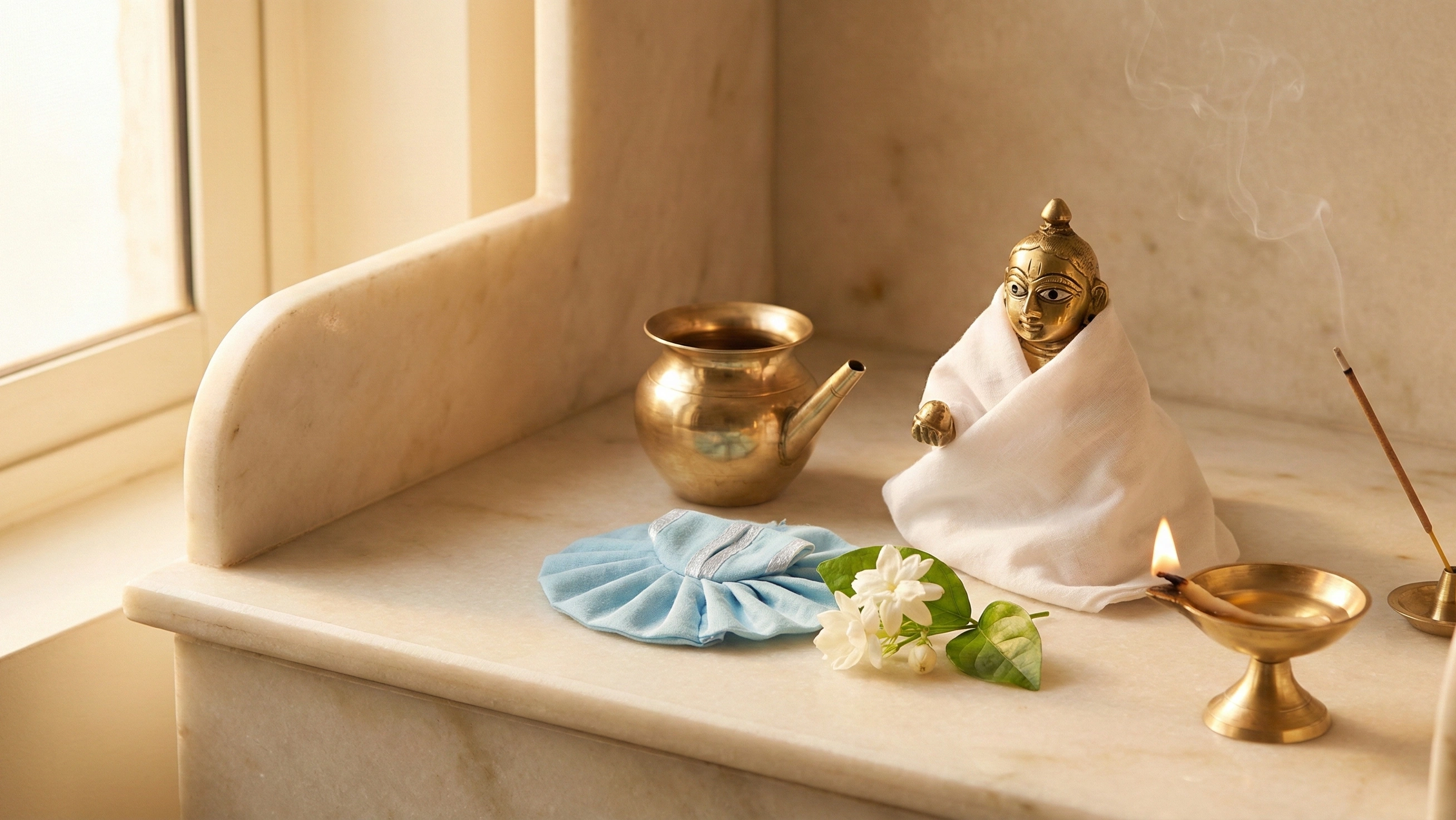
A well-made adjustable poshak solves the fit problem not by being larger or smaller but by giving the dresser control at the point of wearing. The most common feature is a simple set of ties at the back — thin fabric or cord loops that are knotted after the poshak is on, allowing you to cinch or loosen the fit without straining the seam. Drawstring closures work on a similar principle, running along the inner hem to gather excess fabric evenly around the torso. For poshak with more structure or embroidery, small hidden hooks are sewn into the back panel so the front face remains smooth and uninterrupted. These features are not afterthoughts. They are considered design choices that make a poshak genuinely versatile — suitable for idols that are slightly rounder or slightly narrower than the standard proportion for that size. When you shop for a poshak and find yourself between two sizes or dealing with an idol that has an unusual build, always look for these adjustable features before deciding.
- Back ties: knotted after wearing, giving direct control over how snugly the poshak closes at the rear
- Drawstring hem: gathers excess fabric evenly along the lower torso without bunching the front panel
- Hidden hook closures: used on structured or heavily embroidered poshak where visible ties would interrupt the design
- Elasticated bands at the neck opening: common in simpler cotton and georgette poshak, providing gentle stretch without distorting the neckline
- Side gussets: small fabric panels that expand the torso width without affecting the front design, used on poshak for rounder idols
Tip: When using back ties, always knot them in a loose bow rather than a tight knot. This protects the tie fabric from stress and makes undressing Thakurji at the end of the day effortless.
The Golden Rule: Always Size Up
Among experienced devotees, one piece of advice comes up again and again when discussing poshak fit: when in doubt, choose the larger size. This rule exists because a poshak that is slightly generous is always workable — you draw the ties, tighten the drawstring and the excess disappears into a clean, snug drape. A poshak that is too small, however, has no solution. Forcing a tight poshak over the idol risks scratching the murti's surface finish, stressing the fabric seams at the neck and armholes, and distorting the embroidery by stretching the base cloth. The front panel, which carries the main design, can shift off-centre when the poshak is under tension. None of these problems are easy to fix. So the practical rule is straightforward: if your measurements sit at the boundary between two sizes, or if your idol has a noticeably full stomach or wide shoulders, select the next size up and rely on the adjustable features to bring the fit in.
- A poshak one size too large can be adjusted using ties, drawstrings or a neat tuck at the back
- A poshak one size too small will pull at the seams and shift the front design off-centre
- Idols with unusually round bellies or broad shoulders should always be sized to the widest measurement, not the height
- If your idol has prominent outstretched arms, check sleeve width before ordering — arm openings are often the tightest point
When Custom Stitching Is the Right Answer
Standard sizes with adjustable features cover the vast majority of Laddu Gopal idols in Indian homes. But there is a category of murti where no standard poshak will ever sit correctly, no matter how many ties you adjust. A family heirloom idol passed down across generations — often an older brass or panchaloha murti (five-metal alloy idol) made by a craftsperson from a regional tradition that no longer exists — can have proportions unlike anything in the current market. The same is true for very large sinhasan (throne) idols above Size 6, murtis with an unusually pronounced belly curve, and idols where one arm is positioned at an angle that standard sleeve openings cannot accommodate. For these Thakurjis, custom stitching is not a luxury — it is the only way to achieve a poshak that looks and feels right. The process is simple: share the three key measurements (height, torso circumference, arm span) along with a photograph of the idol placed next to a ruler, and a poshak can be made precisely to those dimensions, in any fabric and design from the standard range. Custom orders typically take between seven and ten working days.
Tip: If you are requesting a custom poshak for an heirloom murti, take a clear photograph from the front and one from the side. The side profile often reveals the depth of the belly curve, which is the measurement that standard sizing charts cannot account for.
Singhasan and Its Alternatives: Where Thakurji Rests
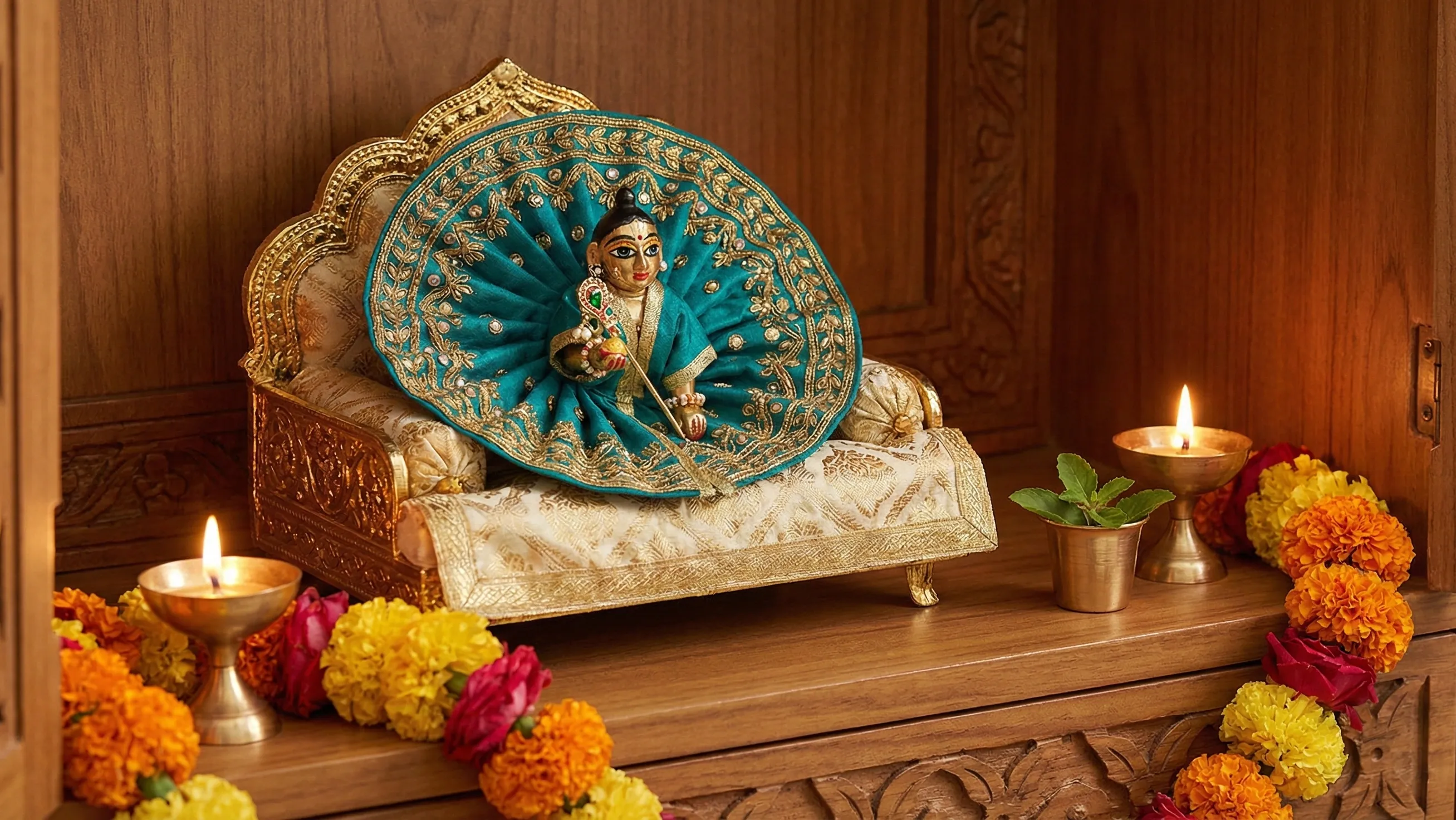
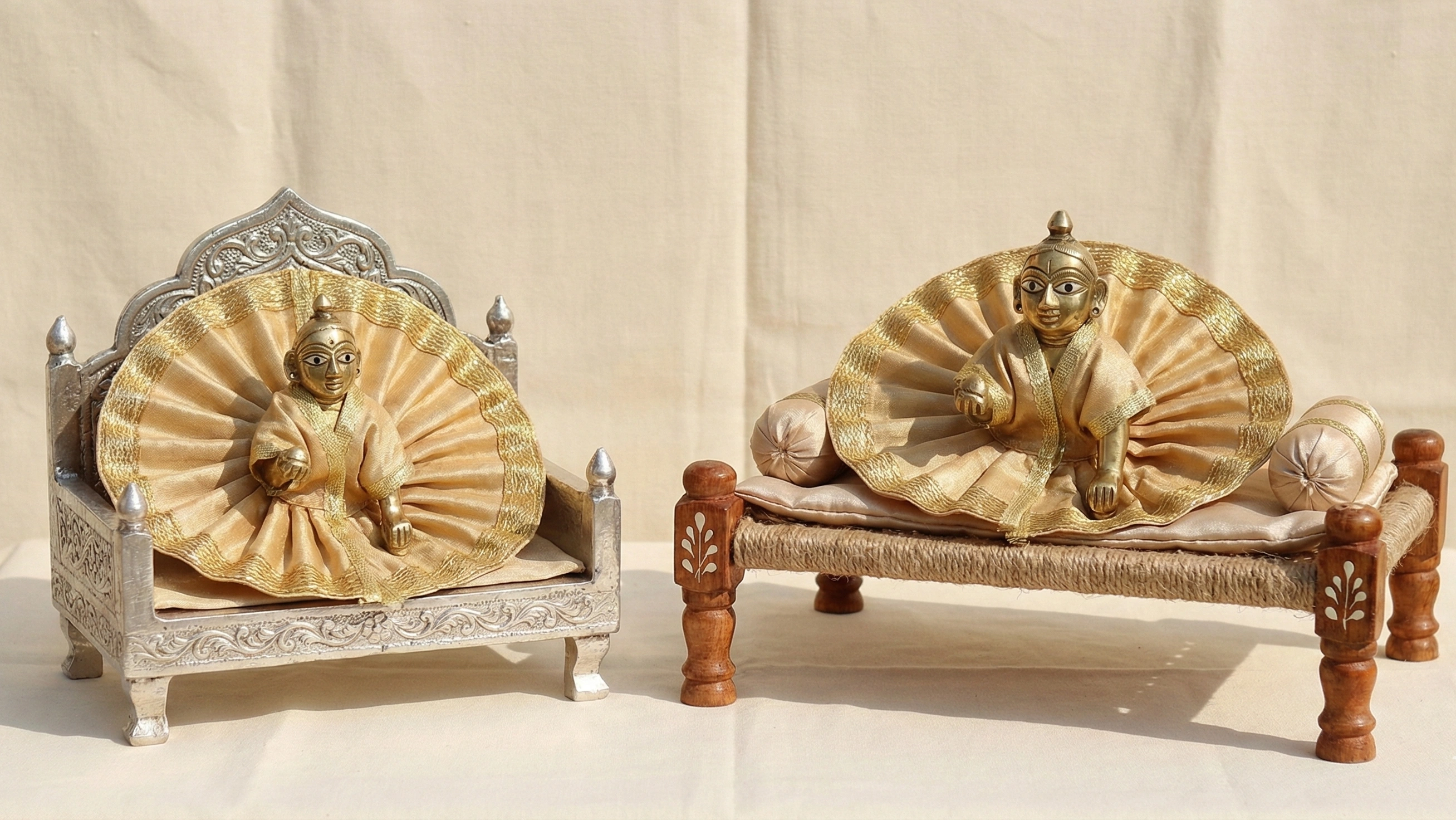
Equal in importance to how the poshak fits is where your Kanha Ji sits. The singhasan (throne or decorated pedestal) is the traditional choice and remains the most widely used seating arrangement for household shrines. But not every home has space for a full singhasan, and not every murti is best served by a formal upright seat. The wooden charpai (miniature cot) has become a beloved alternative in many homes — small-scale versions made specifically for Laddu Gopal are available in beautifully carved designs and are especially appropriate for the shayan bhog (resting offering) tradition, where Thakurji is laid down to rest between aarti times. A palang (small decorated bed) fitted with a gadda (mattress), takia (pillow) and a rajai (small quilt) takes this one step further, creating a complete resting environment that reflects Kanha Ji's identity as a beloved child being cared for at home. These resting arrangements are not informality — they are a specific form of seva, and they transform the shrine into something warm and intimate rather than simply ceremonial.
- Singhasan (throne pedestal): the formal seated arrangement, traditional and widely used; available in brass, silver-plated wood, and painted wood
- Wooden charpai (miniature cot): appropriate for the shayan bhog tradition; allows the idol to be laid on its side in a natural resting pose
- Palang with gadda and takia (bed with mattress and pillow): creates a full resting environment; the rajai (quilt) draped over the idol is one of the most affectionate gestures in home seva
- Decorated palna (swing cradle): suspended or stand-mounted, traditionally used during Janmashtami and Jhulan Yatra but loved year-round by many devotees
- Raised wooden platform with cushion: a simple, practical option for small shrines where space is limited but a soft, stable surface is still wanted
Principles for Choosing the Right Seat
Whatever seating arrangement you choose for your Laddu Gopal, three principles should guide the decision. The first is comfort — not in a sentimental sense, but a practical one. The seat should fully support the base of the idol so there is no rocking or tilting. A Thakurji that leans to one side, even slightly, will shift the mukut, disturb the poshak drape, and make the shrine look unsettled. The second principle is stability. The seat itself should not slide on the shelf surface. A piece of non-slip fabric beneath the singhasan or charpai solves this immediately and protects both the seat and the shelf from scratching. The third principle is accessibility. You will be dressing and undressing Kanha Ji once or twice daily — the seat should allow you to reach the back of the idol comfortably to work the ties and closures of the poshak. A seat that is positioned too deep in a cupboard mandir or too high on a shelf makes every shringar more laboured than it needs to be. Choose a position where you can work with calm, steady hands. The whole point of a good seat is that it makes seva easier, more joyful, and something you look forward to every morning.
Tip: Place a small square of velvet or thick cotton fabric under the idol within the singhasan or on the charpai surface. This cushions the base, prevents any finish wear on the murti, and keeps the idol from sliding when you work the poshak ties.
Tags